


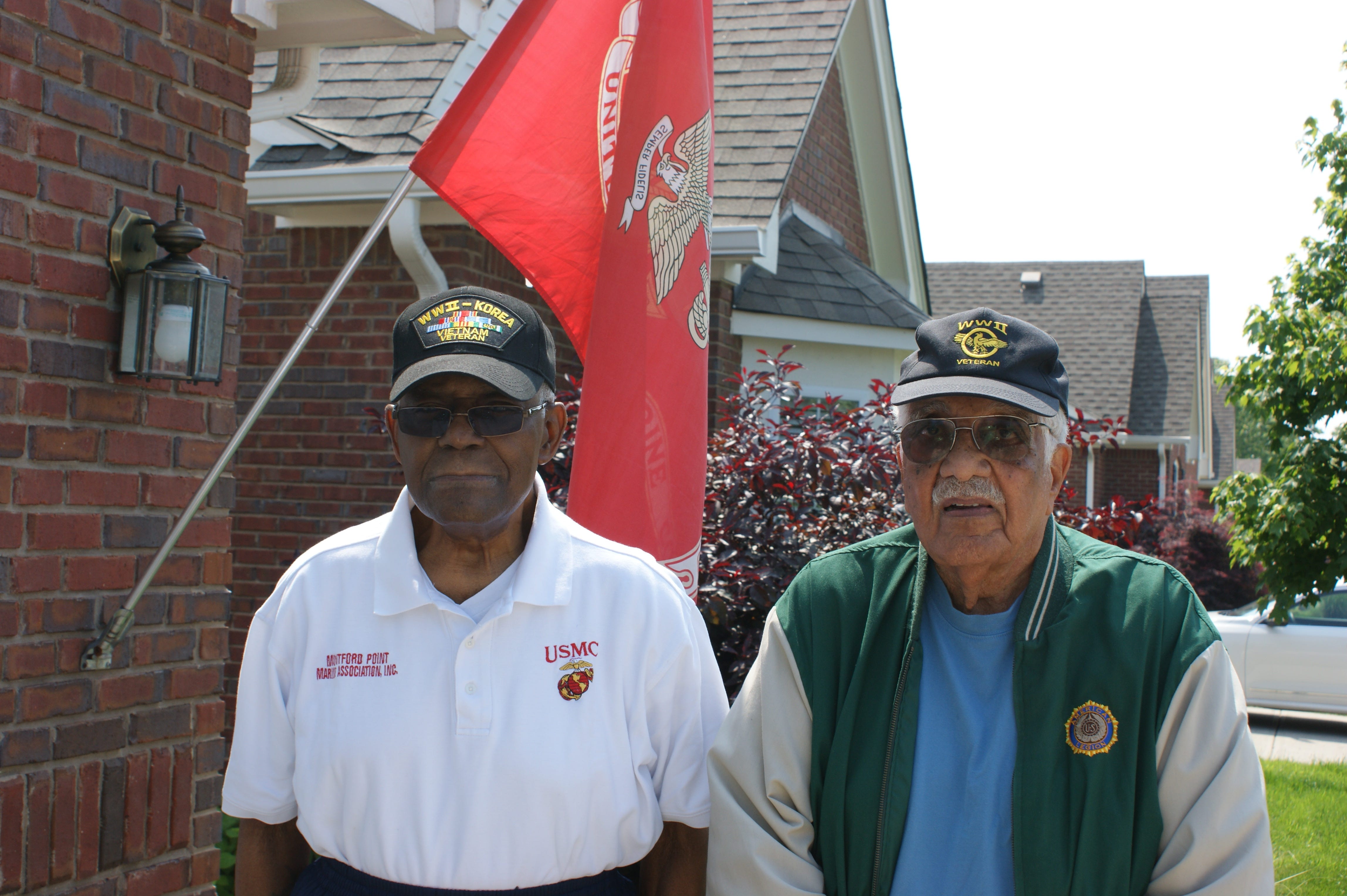
Being in the presence of Lt. Averitte Corley and Sgt. Johnny Washington was being in the presence of history itself. They were both proud members of a special moment in history, shattering glass ceilings and leading the way for change in the U.S. military. Montford Point Marines were the first Black Marines.
They sat down with me in Sgt. Washington’s living room for their interviews in 2015.
Lt. Averitte Corley
Before Corley became a Marine, he felt such a strong desire to serve his country that he dropped out of Crispus Attucks High School in Indianapolis, lied about his age, and joined the US Army Air Corps. Shortly thereafter, on the grounds of Fort Benjamin Harrison, Corley saw a peculiar sight: a unit of Japanese Americans in training. Corley would later find out that this unit—the 100th Battalion of the 442nd Regimental Combat Team—fought alongside the 92nd Buffalo Soldiers in Italy and Europe, becoming one of the most decorated units of the war.
Speaking with the awe of a curious youth, Corley speaks of meeting a Tuskegee Airman while he was loading C47s. Corley was deeply impressed that the Airman had access to the officers’ quarters and was truly inspired by him. It did not take long for Corley’s true age to be discovered, and he was given an Honorable discharge. Corley then began working on the family farm in Hamilton County until he was of age to reenlist, this time with the Marines.
Camp Lejeune in Jacksonville, North Carolina, had a separate camp for blacks; this was Montford Point. Corley shares that their black drill sergeants were tougher on them than their white drill sergeants.
“They wanted us more prepared, tougher, stronger and more focused than any other Marines, and we had to be. And given what was ahead, we needed the strength and moral character to lead,” shared Corley.
Corley was part of the group that relieved the soldiers of the 52nd on Saipan. There he guarded Japanese POWs. “I was in charge of feeding seven of the largest and meanest Japanese soldiers I’d ever seen. They only wore loincloths and had murdered and cannibalized a family of locals and were to be hanged.”
On one occasion, Corley describes an interesting situation en route to the chow line: walking toward him, seemingly leaving the mess hall, were three men. Corley knew that two of them were US soldiers, but the third was a Japanese officer who had come out of hiding, casually walking alongside the soldiers. Corley pulled his gun on the fugitive and told him, “Hands up!” to the surprise of the oblivious soldiers.
For his actions, Corley was given a promotion and transferred to Guam, where he oversaw four other Marines and was issued a vehicle for transport. At the time, this was against the segregated protocol of the Marines. Corley received little, if any, friction for his new promotion and was treated respectfully.
Corley was honorably discharged as a 1st Lieutenant in August of 1947. In 1949, Averitte Corley formally graduated from high school and, using the GI Bill, attended Purdue University, where he majored in Agriculture. He then earned a master’s degree in Counseling from Indiana University. Corley spent a long career with the Indianapolis Police Department, retiring as a Sargent and then working for the US Postal Service.
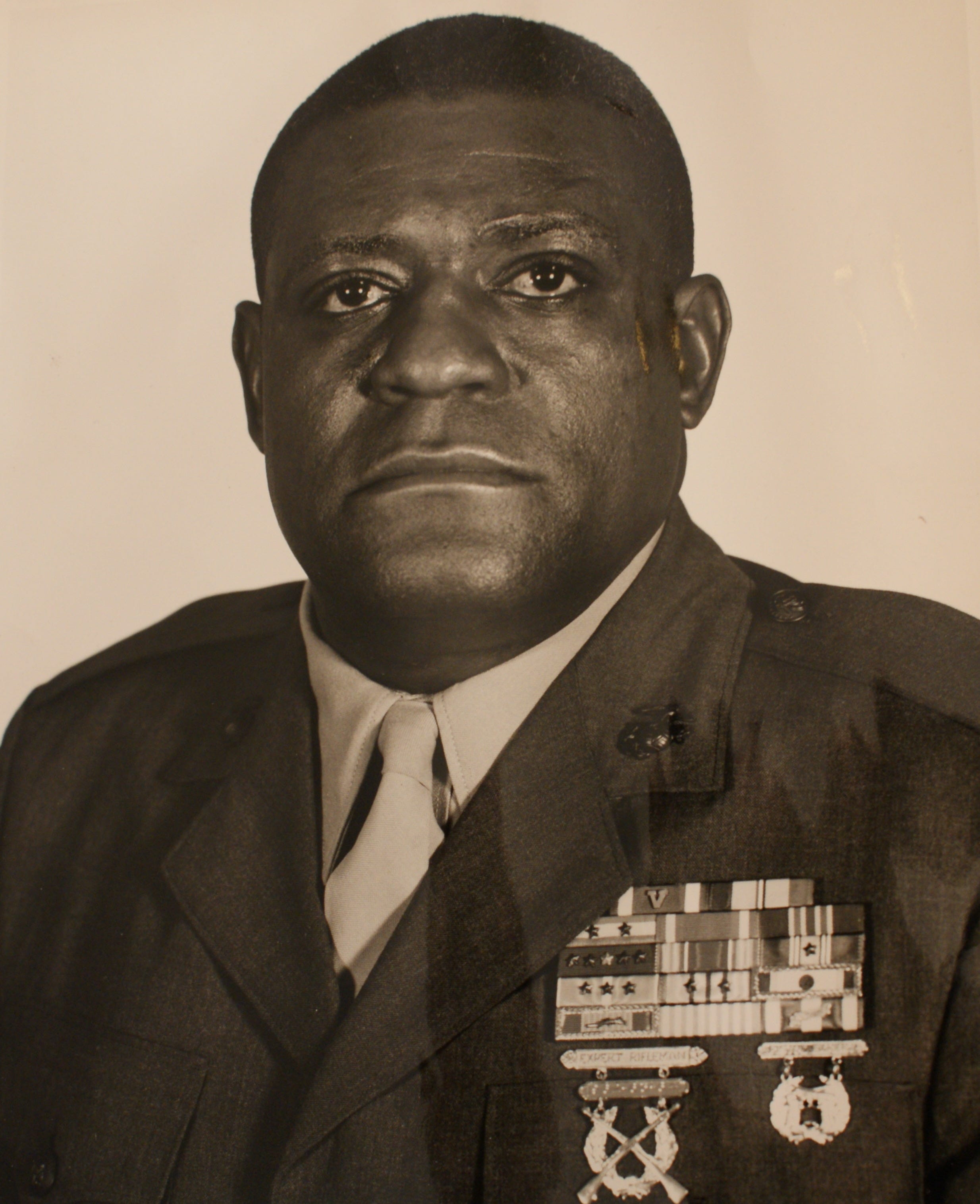
Regimental Sgt. Major Johnny Washington
Sgt. Major Washington made a career for himself in the Marines; he served for 30 years before retiring, having served in not just WWII, but also Korea and Vietnam. Not many soldiers can claim all of those on their record and live to tell.
“The Marine Corps is the story of my life”, says Sgt. Major Washington, “starting with boot camp where the civilian life is erased, establishing a military foundation.”
Being a Marine established such a strong foundation for Mr. Washington that he claims he couldn’t get enough of it. “I’ve seen more than my share of combat, and I still miss it,” states Washington.
When Washington and his platoon were preparing for Korea, the experience was different from the 1940s, for this was the end of segregation in the military. Washington states, “Color was never a problem with the Marines. All blood is red.” After 12-15 months of combat in Korea, Washington returned to Lejeune, which was the home sweet home that he and his family would return to every few years. Few soldiers lived in as many different locations around the world and in the United States as Washington has.
Sgt Major Washington is one of the most-decorated Montford Point Marines, having served in three major wars and been rewarded for his acts of bravery. He was also a no-nonsense platoon commander who was the toughest on his men.
“I would be given the rowdiest, laziest group of boys and turn them into one of the best platoons of soldiers. Boys to men is what they would become under my command. The troops didn’t like it, but I did my job.” Regimental Sgt. Major Washington would spend his final months in active duty working alongside the Inspector General.
Not long after this interview, I spent some time with a few current Camp Lejeune Marines while in North Carolina. They looked at me with a sense of awe as I shared my conversation with Washington and Corley. One soldier asked, “What was it like being in their presence?” I smiled with tears in my eyes, for these heroes/soldiers/men of valor invoke awe with Marines today.
This is the stuff of legend. Corley and Washington are members of a small, exclusive club of Proud Montford Point Marines.
“Once a Marine, always a Marine.” Said Sgt. Major Washington. “Oorah!”
Their stories originally appeared in Geist Magazine.